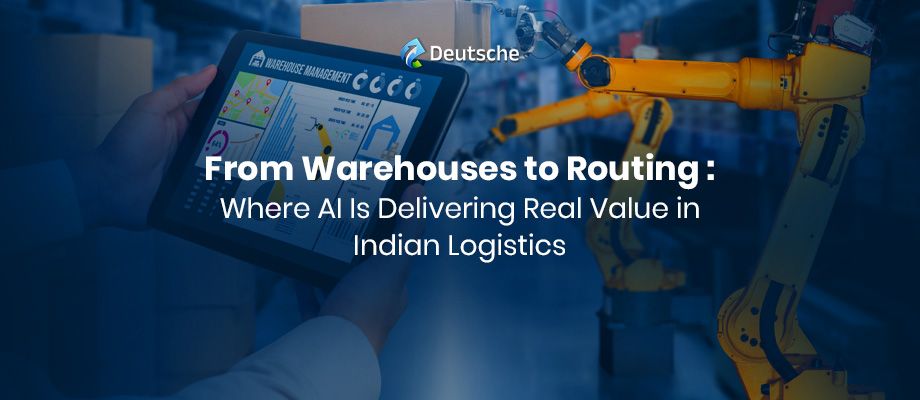
AI and Automation: The Next Frontier in Indian Logistics
If you've spent any time in the Indian logistics sector, you know the feeling all too well. It's the late-night phone call about a container stuck at a congested port. The frustration of a truck delayed for days by unforeseen road closures or paperwork. The financial sting of warehouse space overflowing with slow-moving stock, while your best-selling items are perpetually out of stock.
For generations, the heart of Indian logistics has beaten to the rhythm of human grit, complex relationships, and sheer hard work. This spirit built an empire. But today, in the face of razor-thin margins and customers who demand Amazon-speed delivery, grit alone isn't enough. The industry stands at a crossroads.
The path forward isn't about working harder; it's about working smarter. The most significant shift since the advent of the container is here: the intelligent integration of Artificial Intelligence (AI) and Automation. This isn't a story of machines replacing people. It's a story of powerful technology empowering human expertise to achieve what was once impossible. Let's navigate this new frontier together.
The Indian Logistics Puzzle: A Landscape Ripe for Change
India's logistics potential is monumental, fueled by a booming economy and digital-native consumers. Yet, the ground reality is a web of complexities:
- The Inventory Blind Spot: Warehouses often operate on gut feeling, leading to costly overstocking or frustrating stockouts.
- The Routing Roulette: Static delivery routes crumble in the face of India's dynamic traffic, weather, and infrastructure.
- The Customs Conundrum: Manual, document-heavy clearance processes create unpredictable delays of days or even weeks.
Navigating this environment has always been a high-stakes challenge. AI and automation are the strategic tools providing the clarity needed to not just navigate, but to master it.
Demystifying the Jargon: What Do AI & Automation Truly Mean?
Let's move beyond the buzzwords. In the context of logistics:
Artificial Intelligence (AI) is the digital brain of your operation. It's the capability that allows systems to learn from historical data, identify complex patterns, and make predictive decisions. It doesn't just report what happened; it tells you what will happen.
Automation is the reliable, tireless muscle. It involves using technology to perform repetitive, rules-based tasks with minimal human intervention, from moving goods in a warehouse to processing a thousand invoices.
Together, they form a symbiotic partnership. The AI brain analyzes and directs, and the automation muscle executes with precision and scale.
The Intelligent Leap: AI in Action Across the Supply Chain
How does this partnership translate into tangible results? Let's break it down across three critical pillars of logistics.
1. The Cognitive Warehouse: From Cost Center to Profit Engine
Gone are the days of the warehouse as a simple storage shed. The modern, AI-powered warehouse is a dynamic, responsive nerve center.
- Predictive Inventory Management: AI algorithms digest sales trends, promotional calendars, seasonality, and even macroeconomic indicators to forecast demand with stunning accuracy. This means you stock what you need, where you need it, dramatically reducing capital tied up in idle inventory.
- Robotic Efficiency: Automated Guided Vehicles (AGVs) and autonomous mobile robots work alongside human staff, fetching and moving goods, reducing walking time and physical strain, and operating safely around the clock.
- Optimized Picking and Packing: AI software calculates the most efficient pick path for every order, directing workers via handheld devices. This simple change can slash order fulfillment times by over 50%.
2. Dynamic Routing: Outsmarting the Indian Road Network
In India, a fixed delivery route is a promise you're likely to break. AI introduces a fluid, intelligent approach to transportation.
- Beyond the Map: AI for logistics planning doesn't just look at distance. It processes real-time GPS data, historical traffic patterns, weather reports, road quality, and even local event information to predict the fastest possible route.
- Real-Time Agility: When a roadblock appears or a delivery is rescheduled, the system doesn't just panic—it recalibrates. It instantly provides all drivers in the fleet with new, optimized routes, ensuring continuous efficiency.
- Mastering the Last Mile: This is where costs balloon and customer satisfaction is won or lost. AI optimizes delivery clusters, suggests the ideal time for delivery attempts, and can integrate with a network of micro-warehouses to bring products closer to the end-consumer.
3. The Automated Customs Agent: Speed and Compliance at Scale
The border is no longer a black hole of uncertainty. AI is bringing unprecedented speed and transparency to cross-border movement.
- Intelligent Document Processing: AI can read, interpret, and cross-verify complex shipping manifests, certificates of origin, and invoices in seconds. It flags inconsistencies for human review, allowing compliant shipments to pass through unimpeded.
- Predictive Clearance: By analyzing data from thousands of past shipments, AI can provide a reliable estimated clearance time for a new consignment. This allows for precise planning and communication, eliminating nasty surprises.
- Smart Risk Assessment: Customs officials can use AI to automatically profile and flag high-risk shipments for inspection, fast-tracking the vast majority of legitimate trade.
A Partner, Not Just a Product: The Data-Driven Consulting Approach
The biggest mistake a company can make is to view this as a simple software purchase. Implementing AI and automation is a strategic transformation. It requires a partner, not just a vendor.
A true data-driven consulting approach follows a clear path:
- Discovery and Diagnosis: We immerse ourselves in your operations to pinpoint your most significant pain points and identify the opportunities with the highest and quickest return on investment.
- Blueprint for Success: We co-create a phased, pragmatic roadmap. Perhaps we start with dynamic routing to achieve quick wins and build confidence, then systematically move towards warehouse automation and predictive analytics.
- Seamless Implementation and Integration: We help you select the right AI logistics software and ensure it works in harmony with your existing people and processes, not against them.
- Continuous Evolution: Our job isn't done at go-live. We monitor performance, feed new data back into the system, and continuously refine the algorithms to ensure your operations keep getting smarter and more efficient.
This journey elevates your team. Your planners become strategists, your warehouse managers become flow optimizers, and your company moves from being reactive to powerfully predictive.
The Future is a Decision, Not Destiny
The next frontier in Indian logistics is not a distant speculation. The technologies are mature, the case studies are proven, and the early adopters are already securing unassailable competitive advantages in efficiency, cost-savings, and customer satisfaction. The question is no longer if AI and automation will redefine the industry, but where your company will be positioned when they do.
Navigating this transformation alone can be daunting. The journey from legacy systems to an intelligent, data-driven operation requires more than just purchasing software; it demands a strategic partner with deep industry expertise and a proven methodology.
This is where a structured, consultative approach makes the difference between a successful transformation and a costly misstep. At Deutsche Consulting, we don't just provide technology recommendations; we partner with you to build a resilient, future-proof logistics operation. Our data-driven framework is designed to de-risk your investment and ensure that every step forward delivers measurable value, from initial diagnostics to continuous optimization.
Will you be disrupted by this change, or will you lead it? The power to choose is in your hands.
Ready to Map Your AI-Powered Transformation?
The journey begins with a conversation. Let's move beyond the buzzwords and build a data-driven strategy tailored to your unique challenges and ambitions.
Contact Deutsche Consulting today for a complimentary logistics transformation consultation.